Thursday, 14 August 2014

Silent Insight and Subtle Sensations

As both a person with Asperger's Syndrome and one who practices mindfulness techniques, though I find myself operating outside my comfort zone on a regular basis when trying to make sense of the social world or when taking up different postures in mindfulness-related exercises, at the same time I feel that both my Asperger traits and mindfulness practice can create a comfort zone 'within'. To help notice what I felt was creating a comfort zone within me, I undertook a ten-day Vipassana retreat at the Dhama Dipa Centre in Herefordshire.

Dormitories, Dhama Dipa
In the Pali language spoken in ancient India, Vipassana means insight into the true nature of reality, put simply how it is, including ever changing. Based on the methods of SN Goenka (1924-2013), a Vipassana retreat is taken in noble silence and no non-verbal communication such as facial gesture/expression or eye contact is permitted either. The purpose of noble silence is to free one of distractions, enabling one to gain insight into and to help purify the mind, being able to experience who you are as you are. Most of the time, our mirror neurons, the parts of our brain which according to neuro-scientists observe the actions of others for us to replicate are focusing on what is happening around us, so we miss much of occurs within us, including in the mind and body. In the absence of communication, except for logistical questions and interviews with the teacher, our mirror neurons that are normally focused on how others are communicating, are turned towards us are turned towards us.


In relation to the confusion that I experience with non-verbal communication, I found this arrangement conducive to my experience of the retreat, as I felt it freed me from such confusion which can sometimes lead to anxiety, and thus a distraction. What is also just as confusing for me and for many other people diagnosed with Asperger's Syndrome is the effect that our own body language is having on others around us when we are often least aware. Where this becomes a source of anxiety is that one can't often be sure of how others feel about them, and can be a bit of a shock is something thinks that we are 'not paying attention' through lack of eye contact or are being intrusive through prolonged eye contact.

Initially, I had set out to do this retreat to make a fresh start with meditation practice. Though I have practised meditation for almost ten years, and though one of the purposes of meditation and mindfulness practice is to come out of your comfort zone, what I had been finding of late was that the approach to routine that I had built up around my personal practice was having the reverse effect of creating a comfort zone, as well as building up anxiety over not having practised yet or should I or should I not meditate today. Courtesy of these effects I had been experiencing, I felt that a 10-day Vipassana retreat with continual practice sessions and experience of meditation not necessary would enable me to start from a beginners approach and would give me the continuity to grow into the practice, allowing any effects, including physical sensations, to unfold as they naturally occurred.

Meditation Hall, Dhama Dipa
After focusing on an area around the upper lip and the tip of the nose for the first four days, participants on Vipassana retreat are the instructed to expand awareness throughout the body starting with the top of the head. While noticing sensations at the physical level, participants are also instructed to use the breath as an anchor of awareness on which to refocus awareness each time the mind wanders. When gradually expanding awareness throughout the body after the first four days, I began to notice so many more physical sensations, including many very subtle ones that I rarely notice normally. From this, I gained an appreciation of how though the body takes up a limited physical space, there is so much various in the elements that it is made up of, including the four elements traditionally associated with Buddhism; Earth, Water, Fire and Air. Such variation in the texture of these elements allow for a huge degree of variation in sensations experienced at the physical level to arise and pass. Down to the atomic level, with there being no real such solidity, including within the body, sensations are passing through us all the time, but we can rarely notice them when our attention is directed to what goes on outside of us in normal life. Sensations that I felt I noticed particularly that are present in normal life but I am oblivious to include the sensation of blood flow and vibrations from the beating heart.

Walking area at sunrise, Dhama Dipa
Noticing physical sensations on a deeper level I also felt gave me insight into the type of attention that I have a tendency to give certain sensations and what I felt was creating a 'comfort zone' within my practice - avoidance. Whereas normally I have a tendency to avoid or resist sensations I find irritating or situations where I may likely experience such physical sensations, during the retreat I found that opening to different sensations during the three sittings of determination where participants are encouraged to to make any major changes to their posture for an hour allowed me to observe them, however awkward they felt. I felt I learned from this aspect of the retreat that avoidance can create comfort zones which can shield us from how we truly are, which can in turn lead to anxiety when one has to step outside this.

With awareness developed from continual patience and practice, one can eventually exert more control over the mind, enabling a person with Asperger's Syndrome to make their Asperger characteristics work for them rather than being controlled by them, including helping to notice and change the type of attention that they give to different bodily sensations, thoughts and avoidance tendencies.


Monday, 16 June 2014

RIP Lorna Wing

The autism world has experience a huge loss with the passing of Lorna Wing, aged 85.  Within the field of autism, Dr Wing is recognised as being the first to coin the term 'Asperger's Syndrome'. More than simply just coining a term that is familiar to readers of this blog and followers of Autism Works, many to whom it applies to either as a person with Asperger's Syndrome or a parent/carer of a person with Asperger's syndrome, Dr Wing's pioneering work broke the mould as to how autism is understood, making a huge difference to the lives of many, including my own.

Dr Lorna Wing, 1928-2014
A psychiatrist and a parent of a daughter with severe autism, Dr Wing was founders of the National Autistic Society. Dr Wing became involved with autism as both a professional in an age when understanding of autism in the English-speaking world was largely based on Leo Kanner's original paper of 1944 that described severe autism, which Dr Wing's daughter, Susie, in Wing's own words 'fitted to a T'. With understanding of autism then being limited, it was assumed, including by many of the professionals of the day, that autism was caused by 'cold parenting' or parental neglect. On the contrary though, Dr Wing's compassionate nature as both a parent and in supporting other parents of children and young people with autism was one of the factors in this myth being broken.

Observing as a psychiatrist that there were far many more children and young people who displayed characteristics of autism but didn't fit Kanner's description. Rigorous research brought Dr Wing to Hans Asperger's original paper, then only available in German. With the help of a translation provided by her husband, Wing's 1981 paper in which she described the term Asperger's Syndrome not only broke the mould within the field of autism, but would make a huge difference of the lives of many, with the help that a diagnosis of Asperger's Syndrome can bring in terms of support (if it can be accessed) as well as the diagnosis enabling one to understand themselves.

Those who have heard me give a talk or workshop will likely be familiar with how I felt my Asperger's Syndrome diagnosis gave me, for the first time in my life a chance to not only understand myself in a much clearer way, but also I felt enabled me to make a personal assessment of myself as to where I could see where my strengths and weaknesses in relation to how I am affected by Asperger's Syndrome. Understanding your strengths and weaknesses can help with key decisions one makes in their life including with education and careers. But not only did my diagnosis enable this, but it also opened me up to a whole new world, which has seen me met many people whom I would not have otherwise met.

'Team Popcorn' at Kilimanjaro
Without Dr Wing's work, autism and certainly Asperger's Syndrome would be so much more poorly understood than it currently is. However, Dr Wing would likely have been aware that remains much work to be done in understanding autism, as NAS Chief Executive Mark Lever said at this year's NAS Professionals Conference, particularly how autism is portrayed in the media, often as 'suffering'. Not only do myself and many other people whom I have met with Asperger's Syndrome not see or feel that we 'suffer' from Asperger's Syndrome, but rather I see that diagnosis as an enabling factor in my life in that it has helped me to understand myself and be able to open up to theirs around me much more, and in this way I feel though I am able to understand how it affects others around me, including family and friends. Together with mindfulness practice, I have found that having an awareness of how my condition affects others around me has enabled me to open up more socially. like many other people with Asperger's Syndrome, I am often almost like an 'actor', in that were most of my non-verbal social skills have originated from is through observation rather than intuition.

Team building at Monkwearmouth
Dr Wing's compassionate nature obviously enabled her to give the best of herself to those close to her. As well as a compassionate nature towards others, a compassionate nature towards oneself can also help a person with Asperger's Syndrome in being able to relate to others around them, just simply by being able to recognise different personal issues and concerns and being able to relate them to their own. Holding different thoughts and feelings in awareness through mindfulness can help develop self-compassion, which also helps one to understand themselves, and once we understand ourselves, it gradually helps us to understand how we come across and affect others around us. For me as a person with Asperger's Syndrome, this kind of understanding  I feel has helped me with social interaction and understanding, to the extent that I am able to enjoy the social aspect of taking part in activities as much as the activity itself, including hiking in a group of people, as experienced during last year's Kilimanjaro trek and the team-building exercise at the REACH event at Monkwearmouth.

With Tara Kimberley Torme, a gifted poet with Asperger's Syndrome
Without Dr Wing's work, I would have had many of the adventures I have had and met the people that I have met, including some very dedicated parents of people with autism, contrary to the stigma that Wing and many others in her parent group faced that autism was a result of 'cold parenting'. For that, I owe her and her long-time research partner Judith Gould so much. My very best wishes go to Dr Wing's family and close friends.

One of the many people whom my diagnosis led me to meet is Tara Kimberley Torme, whose poem provides a good description of Asperger's Syndrome. Click here to read it.

Tuesday, 8 April 2014

Back to School, New Starts and World Autism Awareness Day

An Asperger's Syndrome diagnosis can often be seen as a new start at the point of receiving it, particularly for those diagnosed later in life, including myself. In recent years though, something that I have got to appreciate though is that more than the day that you receive the piece of paper that says you have Asperger's Syndrome being a new start, but each day itself after that is a new start. Not least because your diagnosis will affect you for life situations that you are yet to experience. On World Autism Day, this was a message that I took back to school and also to the local authority as part of a delegation calling for action.

The delegation, organised by Carole Rutherford, a parent of two young adults on the autistic spectrum and co-founder of Autism in Mind (AIM), presented Sunderland City Council with a call for action for more integrated services for people on the autistic spectrum, regardless of where they are on the spectrum from the severe to those at the milder, and often more invisible, end. In providing such services though, provision must be looked at long-term, as like the effects of Autism and Asperger's Syndrome, the needs of adults on the autistic spectrum are not static, which is why to enable long-term focus it makes sense to look at each day in providing services as a new start. 
Monkwearmouth Academy, Sunderland

Next, it was time for me to go back to school! After having given talks, seminars and workshops on Asperger's Syndrome for 12 years, ahead of World Autism Awareness month, I received the request that I had been waiting for most of all, to go back to my former school, Monkwearmouth in Sunderland, and give a talk. The request came about after the SENCo at Moknwearmouth, Suresh Patel, by chance came across my first book Glass Half Empty Glass Half Full and got a surprise when he found descriptions of the author's time at the school. Now an academy, provision of special educational needs has really moved on with the development of an Additional Educational Needs (AEN) unit and also REACH Awards evenings, where pupils are given awards for overcoming barriers to achievement, unlike traditional school awards for best performance in certain subjects or for best grades.

With Suresh Patel, SENCo at Monkwearmoouth Academy, and
 some of the parents and awards winners who attended the evening
One of the original ideals of comprehensive education, which secondary school education throughout much of the UK moved towards in the 1970s was that each day of your school life was a new start, whereas previously, which type of school you went to depended on your performance in the Eleven Plus, taken in your last year in primary education. If you passed, you would go to a grammar school where much was expected of you, but if not, you would go to a secondary modern where you were as good as told each day that you wouldn't amount to anything. I was fortunate that I never had to sit the Eleven Plus, as I am convinced to this day that not only would I have not passed, but the stress and anxiety of my future being determined at such a young age would have been emotionally very difficult for me. As a child I was no different in that I took practically being told 'you're not good enough' hard.  

Despite the move to comprehensive education, academic inequality did still exist throughout comprehensive schools and it is not to say that they doesn't still exist today, as in many cases it does. As well as looking at each day being a new start, the mantra of Monkwearmouth's AEN unit developed by Suresh Patel focuses on starting with the abilities that an individual pupil already has, building on that afresh each day rather than setting expectations, which can put pressure on pupils and thus leading to anxiety.

When giving my speech at Monkwearmouth, to staff, parents and pupils, including those nominated for awards, for the first time, I had walk on music! I was surprised by a Sunderland schools choice of Dire Straits' Local Hero, played at St James Park when Newcastle United come out of the tunnel! Like most of the pupils whom I attended Monkwearmouth with I am a Sunderland fan, even if it may have seemed to some that I could have as easily come from a different planet rather than Sunderland! However, to be treated like a 'local hero' at such an event was an incredible experience, something that I could never have imagined 20 years ago when I left school. What was an even more surreal experience though was getting to do something normally reserved for someone who appears television regularly or with an Olympic Gold Medal or a BAFTA, which was the present some of the awards! Other awards were presented by some of the parents who attended.

With former Head Teacher Jim Farnie
Having parents presenting the awards fitted in with the purposes of Monkwearmouth's REACH agenda, to help build a communication platform between staff and parents and also to open up achievement to more than just a gifted few. I also took the opportunity to pay tribute to my former Head Teacher Jim Farnie, who supported me through some difficult times at the school and whose encouragement and motivation helped when I sat my GCSEs. I remember he said that it was vital that every effort was made until completing your last exam and no matter what your ability, you could achieve grades that were good for you regarding your capabilities, a notion that was true in my time at the school as it is today.

The Everest Base Camp wall clock I was presented with
Within the 20 years since I left Monkwearmouth, inclusion has become a much more topical issue in mainstream schools. To my surprise, I was presented with a wall clock depicting one of my favourite personal achievements, reaching Everest Base Camp, an experience which I feel helped me develop resilience and which Monkwearmouth's residential programmes for the AEN pupils also seem to be helping with. Though diagnosis is much more commonplace when young now, it is also important that pupils being diagnosed when young are given the right support so that they can work to and achieve their potential, giving them not just the confidence but also the resilience to be able to face each new challenge each day presents both during and beyond their time in mainstream school.

A huge thank you to Suresh Patel, SENCo at Monkwearmouth Academy, both for inviting me back to Monkwearmouth and for all his incredibly hard work in making the REACH agenda and the REACH Awards evenings happen. He is an inspiration to both the pupils and the parents. I wish the school all the best with this fantastic initiative, great to see good practice going on in my former school!


Tuesday, 18 March 2014

The NAS Professionals Conference 2014, Walking with Robots, Skiing, Coping with Disappointments and the Northern Lights

As the title suggests, the last few weeks have been eventful to say the least! First I had the honour of giving a seminar at the NAS Professionals Conference, followed by a break north of the Arctic Circle. Beyond eventful, both experiences broadened my horizons in ways beyond initial assumptions that I had.

Let's start with the NAS Professionals Conference 2014. Though the NAS Professionals Conference is, as billed, one of the biggest autism conferences in the UK, I couldn't believe the range of choices of seminars, workshops and stands, completely dwarfing any event I have had the pleasure of speaking at! As well as doing my part at conferences, I also like listen attentively to the other contributors, as I like to feel that there is something new I can learn from different ways in which different people affected by autism (whether on the autistic spectrum themselves or as a parent/carer or professional) that can reinforce my own ability to cope as well as my understanding of autism generally. As one of the speakers at the event, Roy Richard Grinker, a Professor of Anthropology at George Washington University, Washington DC, said, understanding autism is a human continuum.

For me, the highlight of the conference, and many whom I spoke to seemed to be in agreement, was the performance by stand-up comedian and blogger John Williams, who is also a parent of a young man with autism. Williams, whose blog and show is called My Son's Not Rainman, gave a performance that was both very touching and humorous. In talking about his experiences with his son, he described some very helpful approaches for practising mindfulness, which I felt enhanced my own seminar that I gave a day later. First of all, he described that his son had no concept of time, which however awkward it was for attending school on time, also meant low expectation, enabling him to be more tuned into the moment. Then he described the nightmare of a school prom at a mainstream school opposed to the magic of a school disco in a special school. Whereas at a mainstream school prom, how one presents socially and image-wise is paramount, people are too worried either about how they look or how others may make them look to be enjoying themselves, at his son's school disco, nobody cared about how anyone looked or behaved, and as a result were more in tune with the purpose of the event, enjoying themselves, including a blind girl who was so in tune with the music she was in the moment. I know which one of these two events I'd rather be at!

With my new friend Mickey
Both the conference and my break in Tromso, in Norway, northern Norway, presented me with some impromptu ways to practice mindfulness of walking. People on the autistic spectrum new to meditation, especially if they find it difficult to sit still or engage in repetitive movement, can sometimes be put off in taking up the practice because the immediate concept that many of us have with meditation is that of a figure sitting cross-legged with the eyes closed. Interestingly, many people who have found sitting meditation difficult have taken surprisingly to walking meditation. A new friend I met at the conference was Mickey the Robot. Made by  Aldebaran Robitics, NAO robots are designed specifically designed to help children with autism in both special and mainstream schools develop social interaction skills in verbal, visual and tactile senses. One of the first questions Mickey asks you is: 'What do you want me to do?' And then he may ask you if you would like to go for a walk. I offered to take him for a walk and found that, as he only has very small footsteps, I had to be conscious of my own footsteps so that he could keep up with me. A fun way to practice mindfulness of walking, focusing on each movement and the sensations that came with it!

Taking Mickey for a walk!
Heading north of the Arctic Circle to Tromso, Norway, after the conference, I experienced a new activity that was a great way to practice mindfulness of walking, cross-country across the snow-covered Lyngen Alps. It was the first time I had ever tried this type of skiing after previously having done some downhill skiing when a teenager. After having already gained an idea of how big a step outside it is outside my comfort zone walking north of the Artic Circle, when getting off the bus (slippery), walking in different foot gear, cross country ski-boots lighter and more flexible than downhill ski-boots) and skis, was another way to be with sensations present in movement, as well as centre of gravity to stay standing up as much as possible. Knowing where to let the skis do the work for you involved being aware of each gradient you are stepping on, when level, ascending or descending, as well as being aware with your centre of gravity. Our centre of gravity, the keeps us upright when standing is something that is as present in normal day-to-day life, but we are often oblivious to it. Being in touch with your centre of gravity helps one recover after falling over, something which I found myself doing more so when going downhill than going up hill, as I found that I became reliant on the skis to do the work, struggling to slow down! When I next do some mindfulness of walking practice, I will look to notice my centre of gravity more clearly.
Cross-country skiing in the Lyngen Alps, Norway

One of the main reasons why I headed to Tromso for a break, was to hope that I would be lucky enough to see what some of us as far south as Jersey have maybe been fortunate to have seen in the last few weeks if you looked to the sky at the right time - the Aurora Borealis (Northern Lights)! I knew not to expect to see any Northern Lights as the conditions have to be right, even at the magnetic pole, for one to view them. So in case they didn't appear, I had also booked a husky sled expedition, which had to be cancelled due to adverse weather conditions. After the first two nights where low cloud cover obscured any possible views of the lights, as an alternative to the cancelled dogsled expedition, I was offered the chance to visit a traditional Sami (an indigenous people native to northern Scandinavia) home, including a traditional Sami dinner around an open fire. While in tune with the warmth of the fire, the cloud cover later began to break up and I managed to gain a glimpse of a green tinge of Aurora!

The Northern Lights, near Tromso, Norway
At the conference, one of the speakers, Dr Peter Vermeulen, of Autisme Centraal based in Belgium, described happiness as the ability to deal with problems and disappointments, as opposed to their absence. By enjoying the social atmosphere of the Sami visit, it made up for the cancelled husky safari, to the extent where I felt that as unlikely as it looked, if the Northern Lights appeared it would be a bonus. The green tinge of activity I unexpectedly saw lasted just a few minutes before being obscured by cloud cover, but it was magical just being tuned into the moment. When the Northern Lights appeared, however briefly, they were also a reminder of the impermanent nature of calendar time. For the Northern Lights to occur, the Sun loses mass during Solar Storms which hit Earth's atmosphere in the form of electrically charged particles. The more the Sun loses mass the weaker its gravitational hold on earth gradually becomes, making Earth's orbital period longer, which we use to measure time in the form of years.

Such an unstructured and impermanent concept of time is more conducive to noticing the effects of mindfulness practice, as well as lowering expectations, something else comedian John Williams suggested to OFSTED inspectors as an approach to accommodating children like his son in school, rather than them pretending to be X-Factor judges!

Stay tuned to Adventures with Autism Works for another exciting announcement ahead of World Autism Awareness Day next month (April)!

A huge thank you to the National Autistic Society for inviting me to take part in a fantastic event!

Wednesday, 26 February 2014

Coming Out of Sameness, New Starts and the Great Farewell at Shildon

After other commitments I have had so far this year, and more so after a lengthy period of writers block after publishing my third book Mindful Living with Asperger's Syndrome, I have finally managed to get around to posting my first Adventures with Autism Works blog entry of 2014!

As I write this entry, I have a busy period ahead conference wise starting with the National Autistic Society's (NAS) Professionals Conference in Harrogate and then a speaker evening with the NAS Newcastle-Gateshead Branch. At these events I will be speaking on the theme of Asperger's Syndrome and Mindfulness Techniques, including covering simple mindfulness exercises described in the new book.

Having noticed the qualities of mindfulness gradually coming into everyday situations, during practice, I had also begun to notice too much sameness when going over similar practice exercises, assuming the same movements, stretches and postures. When getting a feeling of sameness from an activity, one may have a tendency to feel bored, which can then lead to frustration. Alternatively, frustration can also stem from sameness when one feels that they have found themselves trapped in a routine or comfort zone which then becomes difficult to step out of when needed. However, in continuing practice, I gradually began to notice that the feeling of sameness I was experiencing was a by-product of the type of attention that I had been giving the practice instructions, rather than to the actual sensations experienced during the exercises.

When relapsing into sameness within mindfulness practice or within normal life generally, including within routines and responsibilities present within daily life, applying beginners mind can help.Though the movements, techniques and stretches are similar if not repetitive, what it is that constantly changes are the different sensations of bodily feeling, including noticing how each breath coming in and out when in tune with the breath effects the body as a whole. With closer attention, one can gradually notice that each breath is different as are sensations and bodily feelings that come from it. Each breath and sensation being a unique experience can then almost be like a new start, further tuning one into the present and adding to quality of life with new and different experiences.

To apply beginners mind, sometimes it can help to see the world almost from the perspective of a child. If we remember what it was like when we were children, we may well remember that we looked at things around us, including televisions, telephones, clocks, cars and more, with wonder and fascination, often because they were almost new to us. Though things around us such as certain household items and forms of transport can loose their appeal when they become a standard part of adult life, there are occasions when, as adults, we can almost turn into children when we see things that gave us a sense of wonder as children.

The Great Farewell of A4 Pacifics, Shildon
A recent event where I almost turned into a child again was the Great Farewell of A4 Pacific steam locomotives at Locomotion: The National Railway Museum in Shildon, County Durham. Initially brought together last year at the National Railway Museum at York to celebrate the 75th Anniversary of 4468 Mallard stetting the world record speed for steam traction, 126mph on 3rd June 1938, the six survivors of the class, including Mallard and my personal favourite 60009 Union of South Africa, which hauled last year's Tynesider Special from Newcastle to London King's Cross. Shipped over from North America to mark the occasion were 60008 Dwight D Eisenhower and 4489 Dominion of Canada. Completing the set were 4464 Bittern and 4498 Sir Nigel Gresley. The event was a huge success with over 120,000 coming from far and wide to Shildon to see the six A4s together for what could possibly be the last time, including  man who jetted in from LA to see the six before flying back home immediately the next day!

A4 Pacific 4464 Bittern in action at Shildon
There is something about the appeal of steam trains. Unlike many industrial relics of the past, such as mine shafts and manual typewriters, which in their working days were taken for granted as part of what one would see in daily life but are now seen with a degree of fascination by present-day visitors to museums, steam trains during their service days still had the same wonder to many that they have in the present in museums, on heritage railways and charter specials. Part of the appeal, and one of the inspirations for the Reverend Awdry when writing The Railway Stories, later the TV series Thomas& Friends, is with the sound that they make. It is almost like they are breathing, almost as if they are alive!

Coming back to the breath, by seeing each breath as a new start, to help with future blog entries. Hopefully with continued practice, as well as seeing each breath as a new start, I can also see each blog entry as a new start, as well as each challenge as the start of a new journey.

RIP Harold Ramis 1944-2014. Best remembered in his role as Ghostbuster Egon Spengler, Ramis was also a talented writer and director. Ghostbusters is my personal favourite film of all-time!

Friday, 20 December 2013

A Christmas Krakow and Impromptu Mindfulness

What an interesting past few days it has been for me, starting with a Christmas break in Krakow, Poland, and a mindfulness seminar at the MAIN project in Middlesbrough which included an impromptu element.

As you may remember, my previous blog entry was about the magic of steam trains at Christmas. Something else that is often a wonder at Christmas is the atmosphere of a Christmas market in a medieval town square. For the past four Christmases now, I have had the pleasure of experiencing a Christmas atmosphere in a major European city, including in Amsterdam, Prague, Brussels and most recently, in Krakow, the former royal capital of Poland and home of the European Union's largest medieval town square. All four European Christmas breaks I have had have been beautiful, but here was something extra special about the Krakow Christmas experience. As well as simply just seeing Krakow at Christmas, I also felt that I got to sample a traditional Polish Christmas through a Christmas-themed tour of the city.

Christmas markets in Krakow's historic town square
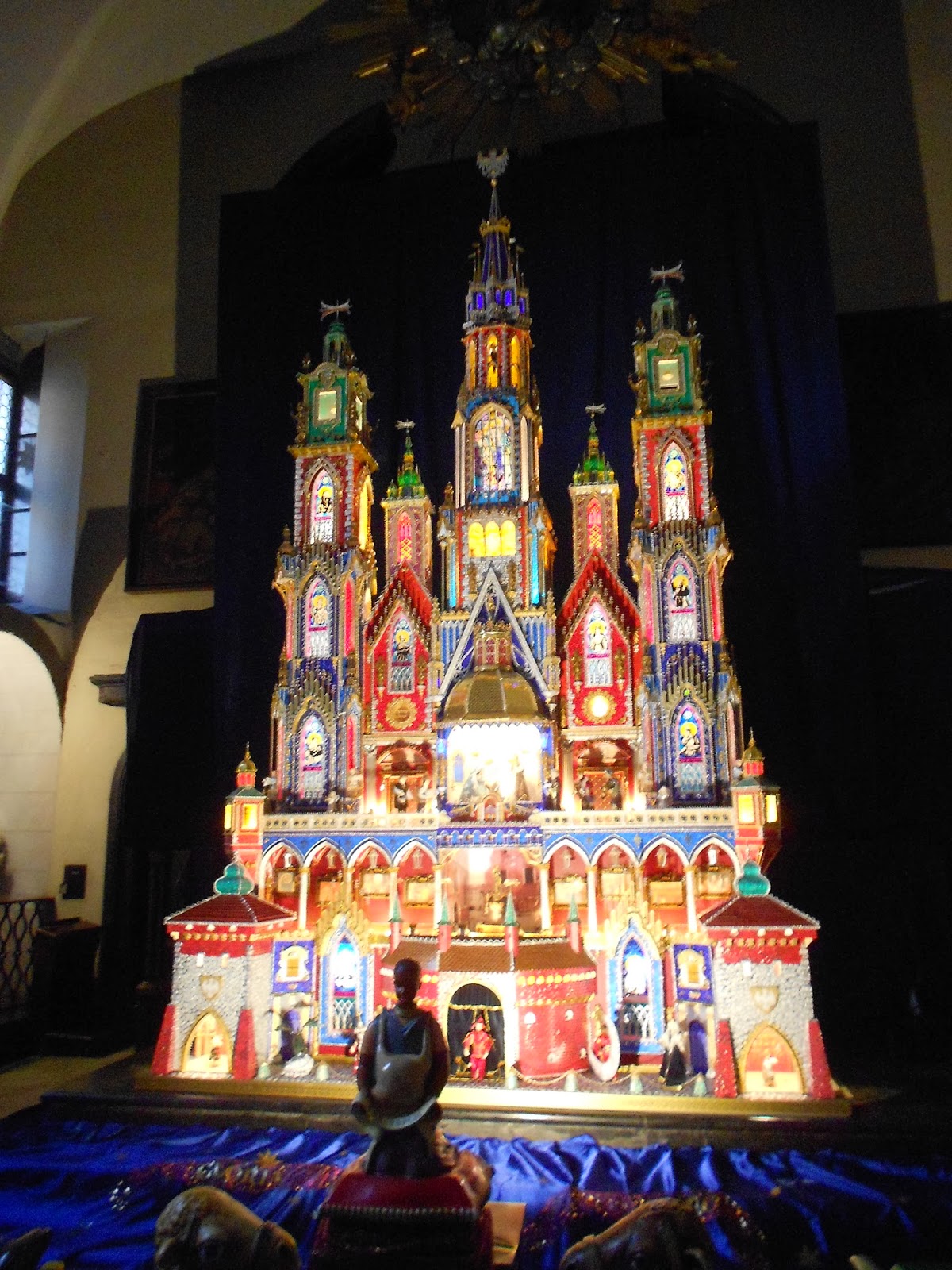
Krakow's town square, with its elegant renaissance-style Cloth Hall at the centre and the imposing gothic facade of St Mary's Church in the corner from where a bugle called is played from the top of it's tallest tower on the hour every hour (which is broadcast on Polish national radio), as well as a historical monument, is also a vibrant centre of present-day commercial activity. The seasonal lighting, colours, scents and sounds that the Christmas market brings to the square also makes it a pleasant multi-sensory experience. On the Christmas tour, I was introduced to the colours of hand-made Polish-style nativities (szopka) on display during the annual Szopka competition held in the town square. The highlight of the tour though was getting to sing Christmas carols in Polish, including the following, which translates to 'glory to the heavens above and to the earth below':
A brightly-coloured Polish-style nativity (szopka)

Chwala na wysoksci (Hva-wah nah vee-sokosh-chee)

Chwala na wysoksci (Hva-wah nah vee-sokosh-chee)

A pokoj naziemi (Ah po-kooy nah zhe-mee)

Another multi-sensory experience I had after returning home from Poland was at a seminar on Asperger's Syndrome and mindfulness techniques I gave at the MAIN Project in Middlesbrough. In addition, I also experienced giving a seminar outside my comfort zone, which involved giving a presentation without the aid of Powerpoint slides! Sometimes, seminars deliver more for both the audience and the lecturer than was expected or prepared, and this one at MAIN was an example.

I didn't realise that I had had a full day allocated for me to give some training, so I had only prepared enough material for a morning session, which consisted of an introduction to mindfulness as well as how it may actually feel to be a person with Asperger's Syndrome. To imagine what it may be like to be a person with Asperger's Syndrome for someone not on the autistic spectrum can involve coming out of your comfort zone. However, something I realised when giving a seminar about coming out of your comfort zone to practice mindfulness was that I was stuck in the comfort zone of giving a seminar on something I was familiar with! What followed was another hour-and-a-half's session which I didn't realise I had, and didn't have anything prepared for! At one time, this would have been a panic situation for me, but by looking at it as an opportunity to practice mindfulness by coming out of my comfort zone and give a presentation not using a Powerpoint presentation and totally impromptu, added another dimension to the event.

Giving a seminar at MAIN in Middlesbrough
In the afternoon session, I co-ordinated a small group session where participants explored the relationship between Asperger's Syndrome and depression, looking at feelings one may experience when relapsing into depression, before exploring how such feelings can trigger certain behaviour and the looking at the consequences that can come from behaviour and how applying mindfulness through simple noticing can help one change their relationship with them, this giving more control over their actions. Something that I felt we all learned from this, including myself, is that individuals with Asperger's Syndrome, when relapsing into depression can then almost feel 'locked-in', when becoming obsessive about such thoughts and feelings, to the point where it becomes very difficult to work their way out of it, rather like being a mouse trapped inside a maze. With mindfulness though, together with applying patience and non-expectation, the route out of such a mental maze can hopefully appear clearer.

From my last workshop of 2013, I felt I learned more than I actually taught. This year I have also learned that travelling can also deliver more than what was perhaps intended when initially setting out, often when you may least expect it. I would like to sign off by wishing all readers a very Merry Christmas and all the best for New Year..

During my visit to Poland, I also found time to visit Auschwitz-Birkenau, which continues to serve as a reminder of the horrors of the Nazi Holocaust as well as a warning to humanity. May the estimated 11 million victims of the Holocaust continue to rest in peace. 

Monday, 9 December 2013

An Early Christmas Present - The Magic of Steam

There is something special about steam trains at Christmas, almost magical! One of my Asperger-related special interests which came to me at a very young age, and is shared by many other adults with Asperger's Syndrome I have met to the point where it has become a stereotype, is steam trains. When seeing a steam train arrive at the platform I still feel just the same as I did when opening a present of a train set as a child on Christmas morning.  

Once again, this year, I have had an early Christmas present of a steam-hauled train journey from Newcastle to London Kings Cross on the Tynesider Special hauled by Class A4 Pacific 4-6-2 60009 Union of South Africa. This journey was special for me as it was the first time that I had gone the full distance down the East Coast Mainline steam-hauled, after having been up and down this route numerous times on more modern traction.

60009 Union of South Africa in Newcastle
Arriving at the platform at Newcastle Central Station during the early hours when it was still dark with old-fashioned carriages, Union of South Africa's entrance into a station dominated by more up-to-date rail traction including Virgin Voyager trains was atmospheric, arriving in a cloud of smoke with its accompanying steam sound. With the station lights on in the background and Christmas decorations in its old-fashioned carriages, the Tynesider Special almost looked like a magic train bringing Santa Claus down from the North Pole!

More than simply a journey, as a person with Asperger's Syndrome and also from a mindfulness perspective, a steam-hauled journey is also a sensory experience. Unlike on a normal modern train, as a passenger on a steam-hauled train, because in this day and age it is not obviously the norm to travel by steam-hauled train, one gets in touch with the with the distinctive sounds made by the locomotive, the smell of smoke and also, a feel of the gradient profile of the line. Whereas one is largely oblivious to gradients on a railway line when travelling on modern traction with modern suspension systems, including tilt trains, when going up steeper gradients on a steam hauled train, it can be quite a drama hearing the locomotive working hard and giving off huge clouds of smoke and exhaust steam, almost like a marathon runner taking longer breaths while working hard in getting up steep inclines of the route. So having been up and down this route numerous times, I haven't felt I have known the East Coast Mainline in such finer detail until now.

On the footplate!
As a passenger, you can almost feel a 'sigh of relief' when the train succeeds in going over a steep gradient as well as a sense of freedom when coming down a bank. Enthusiasts kept a close eye on their speedometers when Union of South Africa came down Stoke Bank, where fellow A4 Pacific LNER 4468 Mallard famously broke the official world record for steam traction, reaching 126mph on July 3rd 1938. When the train reached King's Cross, I had a special experience! After getting off the train to shake the driver and fireman's hands, to my surprise, I got to experience a childhood dream when they let me come onto the footplate! The train was diesel-hauled back to Newcastle, allowing me to spend some extra time in London, including visits to the Science and Victoria & Albert Museums.

Apologies if I have gone on too much about trains in this blog reverting to the Asperger tendency to go off on a tangent about a special interest, so I guess now is the time to change the subject. Meanwhile, back at Autism Works, as some may have already seen on Facebook, we have entered into a formal partnership with Socitm, who will be marketing our services under our trading name see:detail. Socitim is the professional body that represents people involved in the leadership and management of IT and digitally-enabled services for public benefit. Socitim's CEO Adrian Hancock is particularly optimistic about not just providing exceptional service in software testing, but also enabling Socitim to further fulfil its mission in embedding social value into public and private sector supply chains. Additionally, this could also be an opportunity for Autism Works to raise awareness of autism and Asperger's Syndrome through supply chains, enabling awareness with mainstream employers across all sectors, not just within IT.

More updates will follow as to how this partnership develops via our social media feeds.

Special thanks to driver David Blair and fireman Neal Woods for letting me come onto the footplate on 60009 Union of South Africa and to the Railway Touring Company for their hospitality.

RIP Nelson Mandela, 1918-2013. One of my favourite quotes from his long walk: 'After climbing a great hill, one only finds that there are many more hills to climb'. Let's hope Mandela's inspiration will encourage us to climb these hills.